Lip-sync system: 99%+ lower cost than premium video AI
We replaced premium video AI ($3–5/min) with an open-source ComfyUI workflow. Same quality, costs in cents.
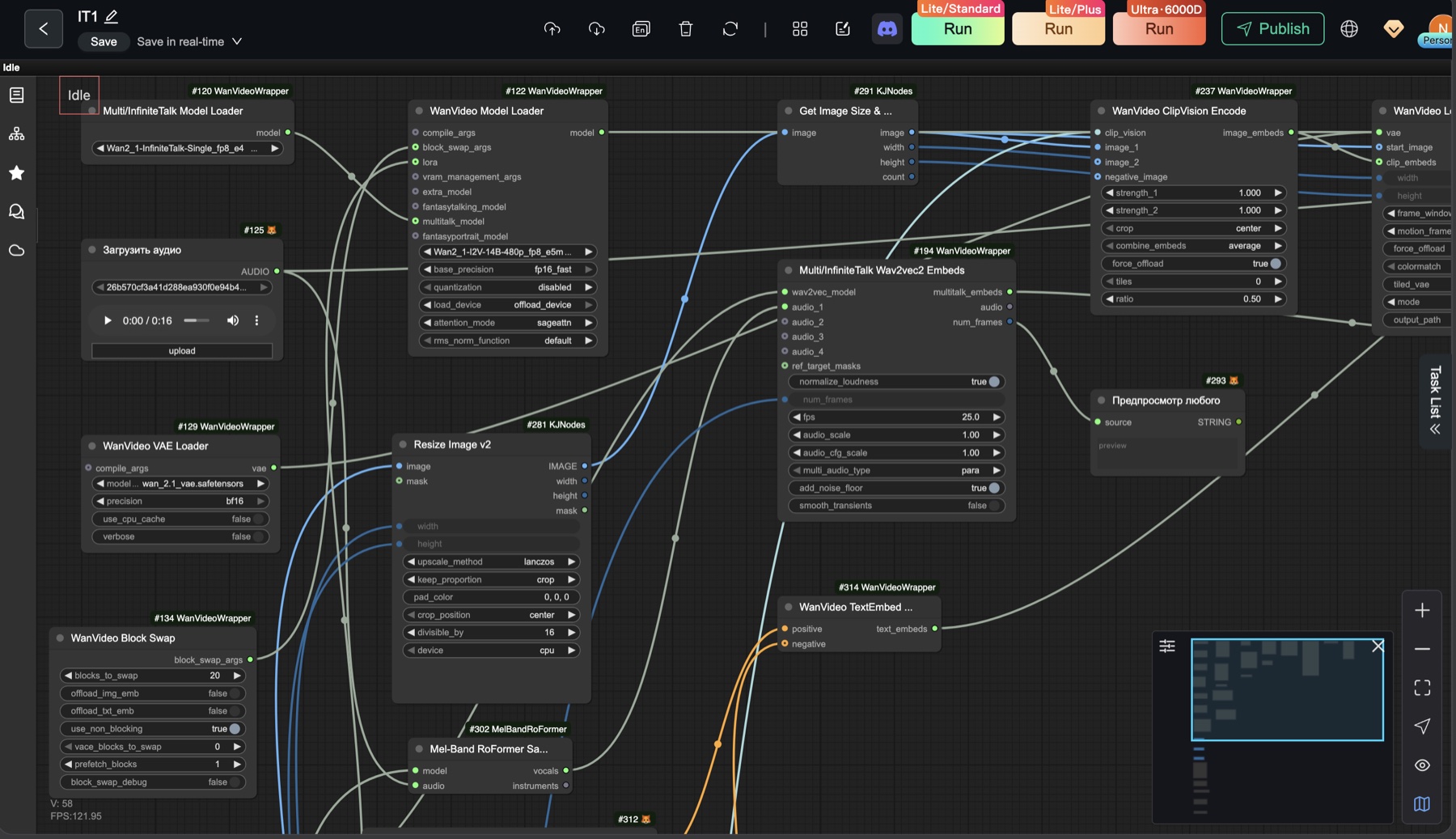
Lipsync pipeline in ComfyUI: Wan 2.1 and InfiniteTalk models, audio embeddings, render
The business problem
A motion design agency that makes ad creatives needed lip-sync video generation at scale. They were paying a premium for a leading proprietary API, roughly $0.05–0.08 per second of video, which came to:
- $3–5 per minute of generated video
- Tens of dollars per finished creative
- Unworkable economics at their order volume
Beyond cost, they ran into API limits, a quality ceiling, and no customization, which constrained their creative work. They needed a noticeably cheaper solution, with no dependence on external APIs and room to adapt it to their tasks.
Our approach
Most teams would either accept premium prices or try to build their own model. We took a third path: we built production infrastructure around the best open-source AI models, with cost-optimized GPU orchestration.
After evaluating the options, we chose Infinity Talk (built on Wan 2.1) as the lip-sync foundation. Key reasons:
- There was no comparable open-source alternative at the time
- The ComfyUI-based architecture allowed deep customization through workflow modifications
- Quality matched the premium API on the agency's tasks, and in some scenarios exceeded it
- It can be self-hosted, removing API dependence entirely
Production architecture
The hard part wasn't running the model, it was getting it to production level.
We built containerized deployment infrastructure that provides:
- A Telegram bot interface (through a local Bot API server for large media files beyond Telegram's standard limits)
- Workflow orchestration for ComfyUI pipelines
- Handling of heavy files (large video input and output)
- Polling and webhook integration with GPU providers
- A Docker template we reuse on similar projects: drop in a config, deploy, done in minutes
The infrastructure design is modular and repeatable. Since then we've used the same Docker template base to deploy similar AI pipelines for other clients with minimal changes.
Cost engineering
This is where the economics get interesting.
Starting premium API costs (their previous solution)
- $3–5 per minute of video
- Tens of dollars per finished creative
- API rate limits
Our first implementation (self-hosted GPU on VAST AI)
- $2/hour to rent an H200 GPU
- Batch processing: dozens of videos per hour on a single GPU instance
- Cost per video: pennies instead of dollars
Current optimized version (RunningHub)
- $15/month flat subscription for the client (50K tokens + access to premium GPUs)
- Effectively unlimited generation in practice
- Cost per video in tokens: ~200 tokens (negligible at this volume)
The optimization path itself shows a key consulting principle: continuous iteration on infrastructure choices. At first VAST AI was the right answer, but when their prices changed and better alternatives appeared, moving to RunningHub gave another jump in the economics.
Photo-to-video vs video-to-video
We implemented both modes, with a deliberate split by use case:
- Photo-to-video: faster generation, fewer hallucinations, often higher quality. The default for most tasks.
- Video-to-video: needed by specific clients with long formats (5–10 minute workflows). At first this mode was broken in the available implementations; we debugged it and got it working, which became a key differentiator.
Nobody in the open-source community had a working V2V at the time, and our next client found us directly through a technical article we published about our Infinity Talk implementation.
Recognition and knowledge sharing
We published a detailed technical teardown of our Infinity Talk implementation, which earned editorial recognition and a strong community response. It became the main reference for people getting into the topic and led directly to new clients.
Result
For the original client: the same volume of lip-sync video at a fraction of the previous cost. No API limits. A workflow tuned to their specific creative tasks. 6+ months of continuous production operation.
The wider commercial impact: 3 paid deployments for different clients with different needs. Each is customized through workflow modifications (V2V for some, I2V for others). The infrastructure base has been reused across several AI projects.
Tech stack
| AI models | Infinity Talk (built on Wan 2.1) |
| Workflow engine | ComfyUI |
| GPU compute | VAST AI · RunningHub |
| Interface | Telegram Bot API (local server) |
| Infrastructure | Docker · Python orchestration |
What this demonstrates
- Production-level open-source AI expertise: not experiments, but commercial deployments
- Cost-optimization thinking: knowing when API services make sense and when self-hosted or alternative providers save a huge amount
- Production infrastructure thinking: reusable Docker templates, proper file handling, messenger integration
- Continuous improvement: willingness to change infrastructure providers when economics or capabilities change
- Expert content: sharing knowledge brings in inbound leads